
Nearly 70% of residential pipe failures are due to bad connections. This emphasizes the necessity of fitting integrity, besides the tubing choice.
Shop For 3 4 Compression Fittings
For installers and hobbyists, a reliable 3/4 inch compression fitting is essential. Such fittings ensure secure, leak-free connections when installed on the right copper tubing types.
Types M, L, and K copper are easy to find, adhering to industry standards for different uses. A 3/4 copper compression union, when properly matched, offers long-lasting durability and resistance to rust. It also helps meet code with codes for both new installations and repairs.
Installation Parts Supply.com sells high-quality 3/4″ fitting parts and matching tubing. This provides contractors and homeowners access to high-quality parts that comply with standards for quality and durability.
Reasons To Use Top-Tier 3/4 Compression Fittings For Pipes And HVAC
Premium 3/4 copper compression fittings provide secure seals no torch needed. Pros prefer them for their ability to facilitate fast hookups, fixes, and upgrades. Such parts offer plumbers and HVAC technicians a robust connection that withstands the demands of the field.
Durability and anti-corrosion properties of copper
The natural resistance of copper to corrosion and its capacity to endure extreme temps render it suitable for many uses. It fits drinking water, AC lines, solar systems, and some fuel lines. Quality fittings, in particular, resist elements, maintaining seal integrity for a long time.
Matching standard copper pipe types
For a tight seal, compression fittings must match the pipe OD and wall type. Types M, L, and K fit most jobs: Grade L is used in residential and commercial water systems, Grade M for standard home pipes, and Grade K for buried or tough jobs. Make sure to check the pipe dimension when ordering a 3/4 fitting part to guarantee it fits.
Residential and commercial applications
These fittings are versatile and appropriate for a broad spectrum of uses. People often use them on potable water lines, branch connections, and supply lines. In HVAC work, they ensure safe operation by fitting refrigeration tubing and matching parts. For mechanical joints in field repairs, a 3/4 compression union or a 3/4 union brass coupler allows easy entry for maintenance and repairs.
| Characteristic | Benefit | Typical Use |
|---|---|---|
| Corrosion resistance | Lasts long in wet areas | Water, solar, HVAC |
| Compatibility with Types M, L, K | Good seal if OD matches | Home and business plumbing |
| Tool-free or simple-tool installation | Quick fixes, less waiting | Service, retrofits, emergencies |
| Brass and copper options | Options for pressure and application needs | Brass for general, Copper for rust protection |
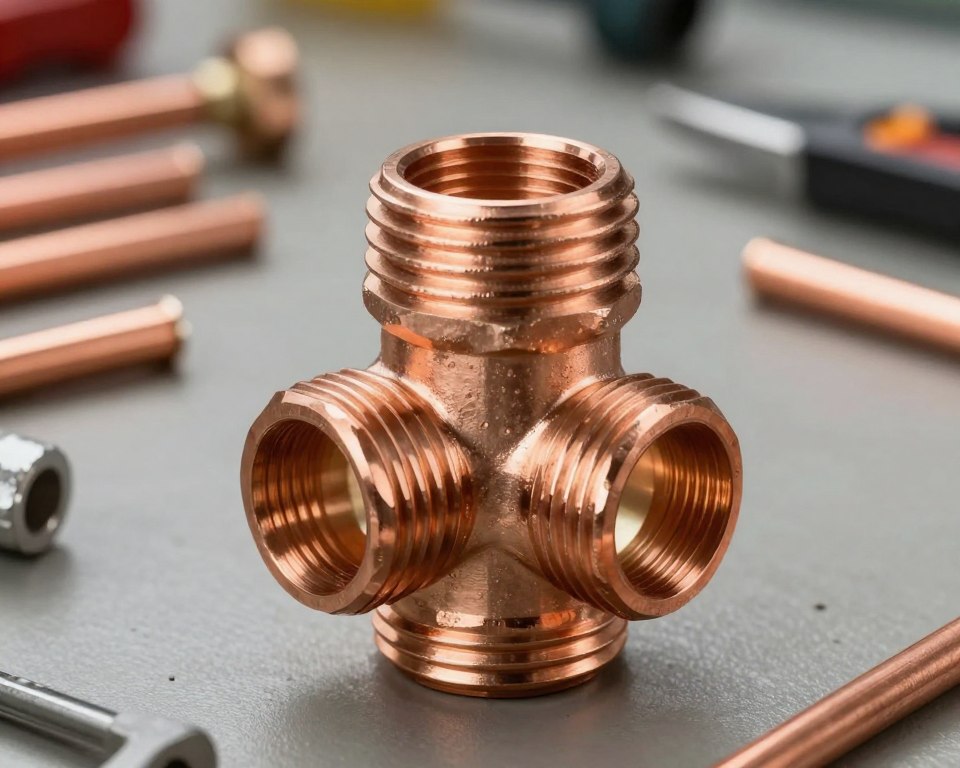
Features, Materials, And Parts Of 3/4 Copper Compression Fittings
Knowing the parts and construction materials is vital to choosing the correct 3/4″ fitting. They form a secure seal no solder required. They handle a wide range of pressure and temp levels.
Parts Of A Compression Fitting
The main components are the body, a sleeve, and the compression nut. Tightening the nut drives the ring against the body. This compression seals the copper tube, creating a seal.
High-end kits often include an O-ring of rubber or EPDM. Certain sets also provide a extra seal, making maintenance easier. Such additions are typical in premium parts for specialized systems.
Material Choices And Finishes
Common materials are pure copper, brass, and nickel-plated brass. Copper parts are perfect for matching copper tubing and reducing galvanic corrosion. Brass parts are the norm for water and AC lines.
Nickel-plated brass gives superior durability and a shiny appearance. Custom caps may be coated or finished for looks and safety. Verify chemical compatibility before choosing decorative finishes for glycol loops or fluid lines.
Common Configurations And Related Keywords
Common forms include unions, couplers, tees, and straight adapters. They are sold as 3/4 compression unions, couplers, or tees for branching lines.
When selecting parts, ensure the 3/4 compression nut matches. A 3/4″ brass coupler is a solid pick if you want brass. Look at the ratings, including pressure rating, temperature range, and if spares come with it.
Below is a quick comparison to guide selection.
| Configuration | Typical Material | Common Use | Remarks |
|---|---|---|---|
| Compression union | Copper/Brass | Connecting 2 tubes | Good for repairs and modular systems |
| 3/4 compression coupler | Brass/Plated | Straight coupling of same-diameter tubes | Complete kit usually |
| 3/4 brass compression coupling | Brass | Potable water and HVAC | Resists corrosion in common plumbing environments |
| Tee | Brass or nickel-plated | Splitting lines | Check PSI rating |
| Adapter | Various | Transition between fittings and valves | Match thread type and seat design |
Use this breakdown to match a nut and ring to the correct body. Correct pairing prevents leaks and makes install faster. Always have spare ferrules and an O-ring ready for field repairs.
Installation Tips And Troubleshooting For 3/4″ Compression Fittings
Ensure the tube type and size match the fitting. Confirm the pipe is the right grade (M, L, K, ACR) and measures 3/4-inch outside diameter. Check for standard stamps if needed. Select matching fittings that match the tube metal to prevent corrosion.
Cutting and prepping the pipe are essential. Use a tubing cutter for a square cut. Remove inner burrs and clean outer burrs for even ferrule seating. Slide the compression nut and ferrule on the pipe prior to insertion into the fitting.
Tubing prep and fitting selection
Determine the fitting style for your joint. A 3/4 compression union connects ends, whereas a coupler connects straight sections. A 3/4 fitting might have special ferrules or O-rings for specific uses. Opt for premium parts in high-pressure lines or cooling jobs.
Install walkthrough
Screw by hand the compression nut until tube hits the stop inside the fitting. Use a wrench to tighten the nut as specified by the manufacturer. Some premium fittings include a Buna O-ring and require little more than hand tightening; always follow the product instructions.
For ferrule fittings, tighten to compress and grabs the pipe. When an O-ring is present, inspect its seating before final torque and have a spare available for field repairs. For hidden pipes, test pressure at design pressure and check for leaks.
Leak causes and solutions
Leaks often stem from a non-square cut, bad rings, poorly seated pipe, or incorrect nut torque. Tightening too much can deform ferrules and loose nuts leaves the joint loose. Replace damaged ferrules or O-rings and cut the pipe straight if necessary.
Recurring drips could suggest the fitting needs replacement or a solid connection such as solder is more appropriate. Keep spare 3/4 compression nuts, ferrules, and O-rings in your kit for quick field repairs. A union or a 3/4 compression coupler can be easily changed when a section must be replaced.
| Problem | Reason | Solution |
|---|---|---|
| Slow drip at joint | Under-tightened 3/4 compression nut or mis-seated ferrule | Tighten to spec; reseat/replace |
| Immediate leak after installation | Bad seal/ring or shallow insertion | Disassemble, inspect O-ring and ferrule, re-cut tube square, replace parts |
| Recurring leaks | Deformed ferrule from over-tightening or wrong material match | Replace fitting with premium 3/4 copper compression fitting or use soldered joint for permanence |
| Union leak | Misalignment or improper nut torque on 3/4 compression union | Realign tubing, check both 3/4 compression nuts, tighten to spec, pressure-test |
| Pressure failure | Incorrect fitting type, e.g., wrong coupler or substandard material | Use certified coupler, test |
Guide To Buying 3/4 Compression Fittings From Installation Parts Supply.com
Begin by examining the material and specifications. Opt for brass, plated, or copper, ensuring they have clear corrosion resistance ratings. Listings should detail operating pressure and temperature limits. Remember to see if it comes with ferrules or spare O-rings. Know the recommended tightening method, whether by hand or wrench.
Choose the fitting type for your job. A 3/4 union is perfect for connecting two tubes same diameter. For straight runs, a 3/4 coupler is suitable. A 3/4 brass compression coupling is great for looks or transitions. Always have spare compression nuts and ferrules for repairs.
Ensure the fitting is compatible 3/4″ OD tubes. Check compatibility with compatibility with M, L, K, or ACR tubing. For HVAC or refrigeration projects, confirm compatibility with ACR and fluids.
Look at the finish and precision features of the fittings. Premium options may offer color or plated finishes that stop tarnish and look better. High-quality seats and precision ferrules stop leaks and ease install.
Before ordering, check stock and shipping times. Installation Parts Supply.com usually stocks a large selection of 3/4 compression fittings and related tubing in stock. Note the shipping deadlines if same-day processing is required.
Review the warranty and returns info. Seek good coverage and a easy returns, such as a 30-day policy for unused parts. Save receipts and order numbers handy to speed up claims for defective items.
Use this guide to make choosing easy:
- Material and corrosion rating
- Pressure/Temp limits
- Included ferrules, O-rings, and installation notes
- Tube compatibility
- Type: 3/4 compression union, 3/4 compression coupler, or 3/4 brass compression coupling
- Stock, Ship time, Warranty
Final Thoughts
Selecting a top-tier 3/4 copper compression fitting guarantees leak-free connections. They are key for residential and commercial systems. They fit standard copper types. Thus you can select the right fitting for the job, guaranteeing life under normal conditions.
For best results, make sure you know the pipe specs. Prep and clean the ends of the tubes. Pick the right fitting that suits your needs. Adhering to these steps and following the manufacturer’s guidelines reduces leak risk and the need for rework.
For reliable parts, visit Installation Parts Supply. They provide dependable stock, copper tubing that meets ASTM/NSF standards, and good policies. By comparing product details, verifying stock, and choosing quality fittings, you ensure secure, lasting connections every time.
Related: Upgrading Your CIP System with Tri Clamp Sanitary Fittings